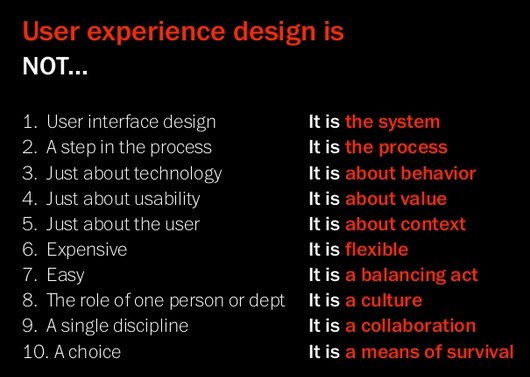
A couple weeks ago I suddenly saw a resurgence of interest in an article I wrote for Mashable in January 2009 titled, 10 Most Common Misconceptions About User Experience Design. Later that year I turned it into a presentation and had a pretty good run with it, until I felt that my message was widely enough understood that I could move on to something else. So you can imagine how surprising it was to see the article and presentation vehemently flying across Twitter four years later.
The next day I happened upon a May 2012 article in Forbes titled 10 Jobs That Didn’t Exist 10 Years Ago. I’m not sure how I missed it when it was first published, but it seemed to be making the rounds again last week. When I saw that User Experience Design was one of the 10 jobs they featured, I came to realize that these two incidents were no coincidence…especially when I read their description of the job.
User Experience Design
What is user experience design? Quite simply, experiences created and shaped through technology and how to make them happen. Case in point: the experience of waking up to an alarm clock is very different from the experience created by the rising sun and chirping birds. A user experience designer’s concern is how to mimic the birds-sun experience through technology (see the variety of alarm clocks on the market that grow louder and brighter to wake you gently). Would-be designers should be fluent in Photoshop, understand programming languages like CSS and HTML and feel comfortable taking an idea from sketch to prototype. As far as demand goes, things are looking bright: a recent indeed.com search returned 168,219 job listings.
The term “user experience” was coined by Don Norman in the mid-90s, though it took a few more years until it was used in a job title. Jesse James Garrett’s formative The Elements of User Experience was published in October 2002, so I suppose it’s true that the title didn’t exist precisely 10 years prior to the publication of the Forbes piece. But suffice it to say, this is not a new profession. I feel very strongly that it is no longer productive to spotlight it for its newness. It is an established discipline with hundreds of thousands of people worldwide bearing the title and receiving a paycheck for it. It is not a fad, not a recent innovation, and not something bleeding edge that companies must be careful when investing in.
But sadly as the field of User Experience has matured, it still seems it isn’t any better understood.
I appreciate the Forbes author’s effort to distinguish User Experience Design from User Interface Design, two very different roles that are often conflated by the media, HR departments, and even the people who practice them. But in describing the emotional events user experience designers aim to elicit, making your alarm clock mimic a natural sunrise is not likely to be one of them.
What I really take issue with are the skills the author lists as necessary to possess for those who wish to enter this field: a fluency in Photoshop, HTML and CSS, and an ability to take an idea from sketch to prototype. I have been a user experience practitioner for a decade and I have never once had to open Photoshop, let alone be good at using it. Yes, I can write HTML and CSS (and even PHP!) when it comes to tinkering on my own blog, but it has never been required of me for a paying job. And as my consulting practice has evolved, I hardly ever sketch and it’s probably been five years since I’ve built a prototype.
Not all user experience designers are alike. I know tons of UXers who live to draw, love to hack, know their way around the full suite of Adobe design products. But it is in no way a requirement to being a successful user experience practitioner. I am proof.
There are in fact skills that every user experience designer must exhibit, regardless of sector, seniority, or specialization:
- A proficiency in building empathy for customer needs
- An aptitude for communicating with colleagues across organizational functions
- The initiative to investigate a problem and generate a multitude of solutions for it
- An eye for intuitiveness and simplicity
- Knowledge of the features, benefits, and weaknesses of a vast array of programming languages and technology platforms
- Diplomacy
- Patience
- Humility
Most of all, what unites all user experience designers is a deep belief that companies should never stop striving to make their customers’ lives better. The tools are interchangeable. The activities are contextual. But the philosophies are the same.
The good news is that people still want to learn what this is all about. They are still fascinated by the field of User Experience and want to understand how it applies to their everyday work. Quite often, they wish to find a way into practicing it. This is an incredibly open and welcoming community. People are always willing to lend a helping hand, offer advice, provide feedback or make an introduction. All you have to do is ask.
Related Posts:
- 10 Most Common Misconceptions About User Experience Design January 10, 2009 | 14 comments
- 10 Most Common Misconceptions About User Experience Design — the presentation April 6, 2009 | 1 comments
- Don Draper is the Antithesis of User Experience February 27, 2012 | 14 comments
- Why CAPTCHAs Fail on Marketplace February 4, 2013 | 3 comments
- Designing for Startups in Smashing Magazine February 26, 2011 | 0 comments


Hi Whitney,
You have some good insights in this post and I appreciate your blog. But how can someone have ‘designer’ in their job title without ever having to implement those skills? Sure design is not just about sketching, prototyping and pretty pictures. While the job involves all the aptitudes you listed above, it also requires research ability, knowing the audiences of the product and ultimately having the sales skills which enable you to convince the client that the solution you came up with is the best one. Are there truly UX jobs out there that don’t require these skills?
Of course! But the term “design” does not presuppose the tools you use to do it. Some people use OmniGraffle or Balsamiq. Some people use HTML and CSS. Some people sketch on paper or on whiteboards. Some people make PowerPoint presentations. Some people write prose. Some people dance around the room telling stories.
My point is that it is highly inaccurate to claim that in order to be a user experience designer one must have proficiency in Photoshop, HTML, CSS, sketching and prototyping. Those are some tools and techniques that some practitioners use. Those are also some tools and techniques that other practitioners never use.
What unites us are our philosophies and our principles. That is what we need to focus on and what we desperately need to promote.
I’m not sure someone can dub themselves a ‘designer’ these days, if they can’t use Photoshop. I also believe any kind of designer in the web industry has no excuse to not be at least familiar with HTML and CSS. I would not expect the designer to be fully proficient in these fields, because that is not their job, but if they don’t have at least some idea, how else would they be able to know if the designs they are creating are feasible or appropriate in code?
I agree wholeheartedly with Whitney on this one. It’s an elitist attitude to assume every designer comes from a background where slapping down thousands for Creative Suite is feasible. Especially when there are free solutions like GIMP or inexpensive solutions like Pixelmator. You can be an excellent designer without having the top tier, most expensive tool out there. Unfortunately corporate America (an in other countries, I’m sure), don’t think about open source or inexpensive solutions often.
Also, some of us design what a product is and does, not what it looks like. Visual designers need to know photoshop (or similar), but I’ve been designing for years with only pen, paper, and Omnigraffle.
I think I agree with “Dixie” in the sense that, as you have said, Whitney, you can write HTML + CSS. That makes you aware of your medium (in this case, web), and therefore understand at least the basic ins and outs of it. Someone who is designing an experience for a web site and does not at least know how HTML and CSS work will not be as useful simply due to the fact that they are entirely outside the execution process. They are not aware of the intricacies of the building blocks of their own work they are not “user experience designers” but simply “quality assurance testers”. While those two things share a lot of overlap, they are not the same profession. I wouldn’t hire an architect to make me a blueprint for a steel bridge if that architect did not understand some of the finer points of working with steel.
I like when you say that we need to promote the philosophies and principles that make us passionate about this field, but there is often a disconnect in practice as to what technical skills are most valuable for UX practitioners to have. I have met ux designers from technical, art and business backgrounds and they were all excellent despite the tools they used, they were effective in their practice. What I am really saying is that a standard for technical skills might need to be discussed further and agreed upon for this field. Perhaps then employers would understand what is involved as well and write better job descriptions or provide necessary professional development opportunities.
Great article Whitney! Funny enough, I referenced your original presentation just yesterday when I gave a talk to the graduating class at an Interaction Design program here in Toronto.
I have often struggled with describing the profession to friends, colleagues and clients, but I think you hit the nail on the head when you talk about the philosophy that binds all the different shapes and sizes of User Experience design together.
I also have a problem with Forbes’ statement that “UX Designer” was a job that didn’t exist ten years ago. It may not have been specifically defined in the corporate world as such in 2002 but the job was being done. Personally, I was hired as an Information Architect in the late 90’s and quickly learned that more than half of my role was fighting for a kinder, gentler user experience. I didn’t start the actual IA part of a project until after those UX battles had been fought and, typically, lost.
Keep preaching Whitney!
It’s hard to argue with your definition, from an academic perspective, but I still find it awkward. Why? Because most ‘in the field’ UX I’m aware of involves synthesis (sketching, prototying, UI) in addition to research/strategy/planning.
When a client asks for us to research, map an experience, identify a UX problem or opportunity, this usually also means a need for a solution (or several). This requires synthesis and idea generation. Because user experiences range context and media from physical to digital, written word, sounds, visuals, video, interactive, music etc… I don’t see how it’s possible to preclude ‘creating’ in the traditional sense of ‘designer’. The UI (physical or digital) for example should therefore definitely be of concern to a UX practioner, and therefore at least some tools are part of the picture. Sure, they don’t have to be a specialist, but completely relegated to a position of analysis and advice? That’s not my idea of UX.
That’s quite true. Formally or informally, we all play both roles from time to time. For instance, at LVL Studio, we have several people who are graduates of formal interaction design programs, and people like myself who are hybrids, combining writing / research / storyboarding along with UX and visual design. At agencies like Cooper, they have a fascinating ‘pair IxD’ model, one person being the ‘generator’ and the other being the ‘synthesizer’. In a product-focused startup, that person might also be a front-end coder / prototyper. In all those cases, however, without thinking about the issues that Whitney mentions, the value of UX can easily, and lamentably, be reduced to “drawing pictures.”
I hadn’t heard of the ‘generator/synthesizer’ pairing, that would be interesting to see.
“…the value of UX can easily, and lamentably, be reduced to “drawing pictures.”
That’s so true, unfortunately. We have to work to dispel this myth. I think Whitney’s message and 10 points slide really highlights how UX has a broader reaching purpose than just focusing on a specific product, process or service.
However, for me, the hybrid model makes more sense. To use an analogy, Web/UI designers who aren’t aware of implementation concerns are likely to fall short of designers who are aware. There’s an intrinsic value within the generator/synthesizer relationship.
By Whitney’s definition drawing may not be required to be a UX practitioner, but this assumes you don’t need to be able to communicate visually at all. I just can’t reconcile that.
While I certainly believe that most designers of any kind prefer to communicate visually, why should they be required to do so if their communication styles and techniques are effective and successful?
Because the medium is often visual and it’s a powerful and effective communication method. Sketching is far more efficient than writing for visual means.
I’ll concede, it must be possible to practice UX without it, as you amply demonstrate. I’ve never seen this style in action, so you’d have to demonstrate or I don’t think I’d completely understand.
An interesting thing to consider: what profession isn’t continually misunderstood?
Certainly some are more misunderstood than others, but even the oldest professions (insert joke here) we have are well misunderstood but anyone who isn’t in them.
Given the endless debates within our community itself over who is or is not a designer, or what our job titles should be, or which conference organizers basically can’t stand other conference organizers, the place I’d put the bullseye for causing the most trouble about UX being misunderstood is the larger UX/design/IA/usability/People’sJudeanFront community itself.
Why does it seems UX designers are always defending their craft? I personally believe UX design is a part of the creative process and very important to the success of a site. But I fail to see how UX design can be a stand alone position, to me its like saying you only turn the oven on but don’t prep the food, cook it, or serve the meal.
How is that any different than anesthesiology?
My current take on a project: discover – strategy – design – development. For us we consider creative as an integral part of the first three parts while the during the forth creative takes a visual QA role. To be successful collaboration is key and, in my experience, to have a person solely dedicated to UX would contradict that. Our online marketing team, our creative team, and the front end team collaborate to nail down the first two parts of the process. To have an individual whose job is to solely do that doesn’t make sense, at least for us. How can one person without a huge amount of experience be savvy enough to make the best possible decisions that incorporate a number of factors like technology, design, feasibility, and budget? Also, how would this person fill their time without being a part of the rest of the process?
My “cook” analogy was meant to illustrate the importance of each part of the process and how they overlap. I understand the “specialist” link you are trying to make. Yet I don’t think UX is a specialty, it touches too many things to stand alone like an anesthesiologist. But I do like the idea of managing pain/consciousness. Those roles are for my project manager and bartender.
Bobby G., out of curiosity: why do your Creative and Marketing only collaborate with “front-end developers”? What did, say, “back-end developers” do wrong to ignore their input? :-)
Jokes aside, I think it always seems that UX Designers “defend” their profession, because it’s a new field and not well-defined yet. As any new profession (especially a creative one) as it matures it goes through stages from being very loosely defined “art” to being a science. UX can not be art, because it has very practical use and as any artist will tell you, art is not about practicality. But before it fully matures it is like art, because it is poorly understood. Computer Science went through that, as well.
In my opinion UX is all about research. People who take UX seriously, first and foremost, conduct a lot of research, they study patterns and behaviors, analyze context and determine optimal solutions. THAT is science, that is skill and as any skill it requires professionals. So UX is a profession :-)
The back-enders are a different type of geek from the rest of us :)
I totally agree about UX being a science, yet a science not based on all facts. It is based on facts, trends, fads, research, personas, experience, perception, etc. That’s why I have a hard time looking at it as a job for one person. A very skilled front-end developer brings a certain expertise to the UX conversation. A senior level designer brings a separate expertise to the same conversation. How can the client and the work benefit more from one person, with limited experience in both of those two crucial fields bring more value than the outcome of the conversation with the front end dev and the designer?
I believe UX manager or UX director is a true profession. For us that responsibility currently falls under the creative director. But it takes a team of talent with varying backgrounds in varying fields to uncover the best strategy. We are an agency that works on many project for clients. So if you are working on a single giant project in-house of for one client, I can see UX being more of a full-time position. Yet still struggle to see how one person can be the expert, versus one person managing a team that determines direction.
Bobby, we are in agreement. I’ve given many-a presentation stating that user experience is everyone’s responsibility. I’ve even gone as far as saying everyone is a user experience designer.
But there is still room for the role of User Experience Designer — facilitator, educator, empathy builder, customer advocate, cross-discipline liaison. The User Experience Designer does NOT serve as the expert on the user; they are the expert on the process. They know what tools and techniques to use in given situations. They know how to ask the right questions, they know how to make sense of the answers. They evangelize the user experience principles and philosophy. I’ve been doing this work for a decade and I can assure you there is room on the team for someone who is focused on these activities.
The best ones don’t do their work in a vacuum, but engage the entire team and build a culture of user experience throughout the organization.
I do agree with you that skills like html/css/js, creative suite, etc, should not be requirements to successful in UX design. However, I can’t help but notice that for someone starting out, trying to establish themselves, they absolutely seem to be.
I am a student and an aspiring UX designer. I have had the experience of interviewing for various UX design positions and also have discussed the process of finding work in the UX field excessively with my cohort of around 50 fellow students. Unfortunately, if there is one commonality, it is that employers are looking for those skills with whatever programing language or design software they use. Yes, there are many employers that also place significant emphasis on empathy for customer needs and the other skills you list, but it seems that they alone won’t get you the job. At least not without years of experience. They might help set you apart, acting as icing on the cake, but the barrier appears to be in the technical side of things. I am not saying I agree with it, but it is the reality for a majority of UX practitioners just starting out.
My favorite dictionary states the definition of “design” n 1 a metal product or scheme : plan 2 a particular purpose : deliberate planning 3 : a secret project or scheme : PLOT 4 pl : aggressive or evil intent – used with on or against 5 a preliminary sketch or plan : DECLINATION 6 : an underlying scheme that governs functioning, developing, or unfolding : MOTIF 7 : the arrangement of elements that make up a structure or a work of art 8 : a decorative pattern. I am partial to #6 an underlying scheme that governs functioning, developing, or unfolding. Hmmm… Don’t see Photoshop mentioned. Food for thought.